A mouth guard quotation is five lines of cost wearing one price. Understanding where the fixed cost sits, and how it behaves at 500 pieces versus 5,000, is the difference between a margin and a surprise.
A mouth guard quotation looks like a single number. It is five numbers added together, and only one of them scales neatly with volume. Buyers who understand where the fixed cost sits can negotiate the parts that move and leave alone the parts that do not. This breakdown covers the MOQ rules, the cost lines that matter, and what actually changes between an order of 500 pieces and an order of 5,000.
The five lines inside a quoted price
Every custom mouth guard price is built from the same five lines, whether the factory writes them down or not.
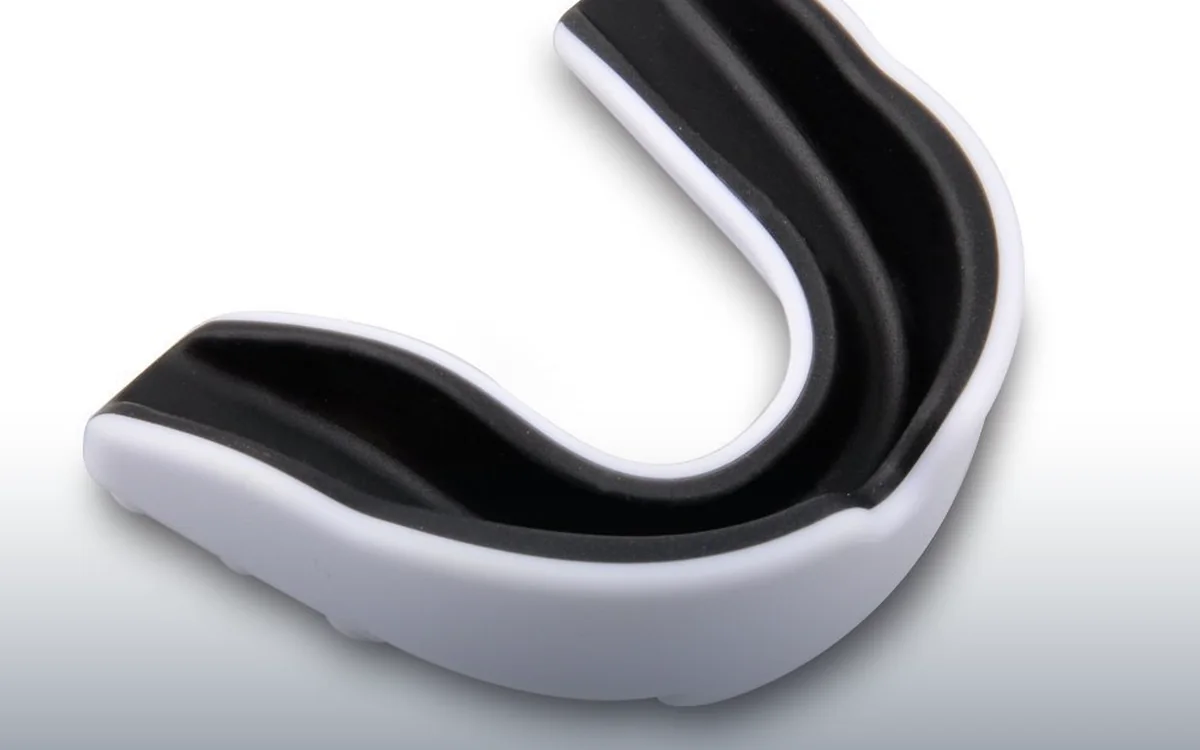
- Material: the shell, the liner, the tether. Driven by part weight and thickness, not by unit count.
- Tooling: the mould, the trim fixture, the print plate. A one-off cost that has to be amortised across the order.
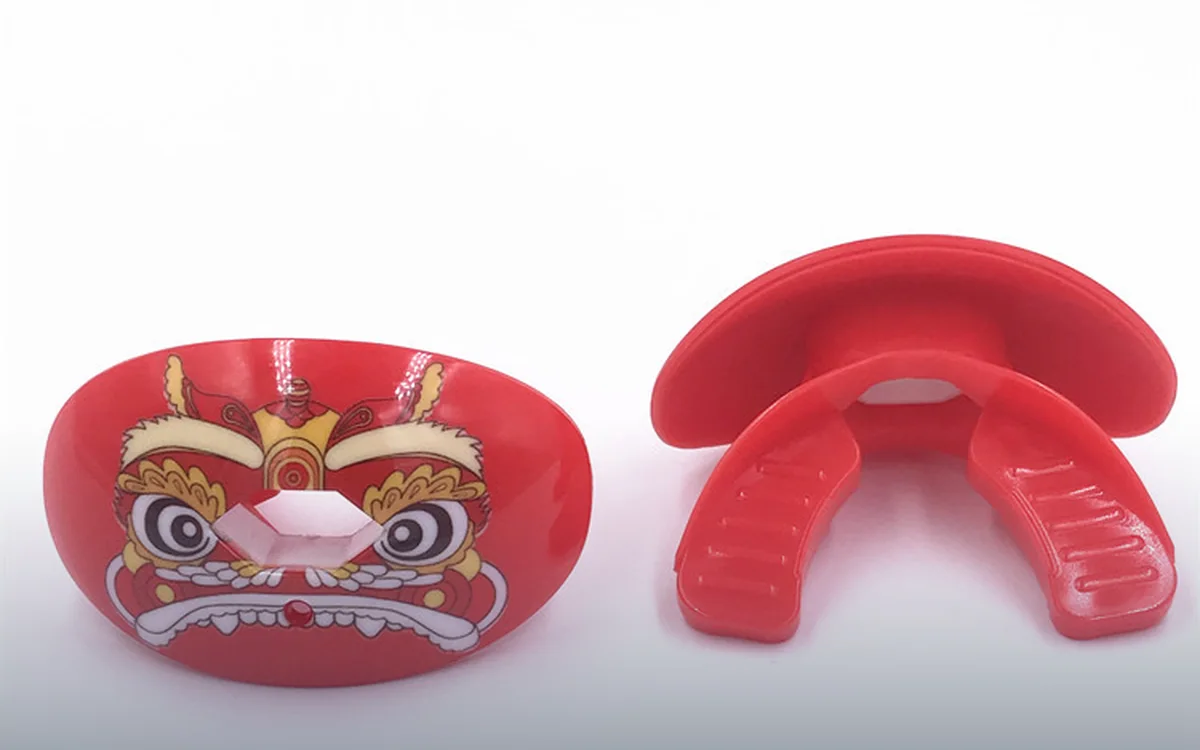
- Decoration: moulded-in logo, print, or a label. Setups per colour, then a per-piece run cost.
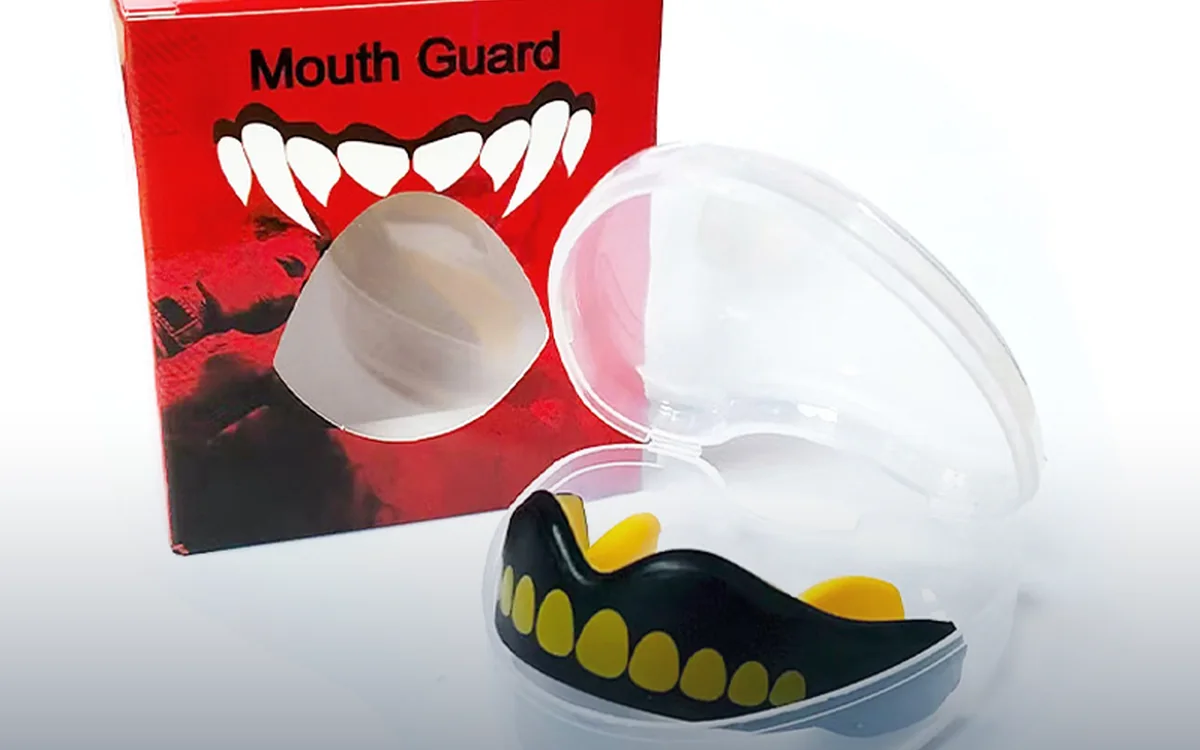
- Case and packing: the PP case, the sleeve or box, the carton and the labour to pack 300 pcs.
- Freight and terms: what moves the goods from the factory gate to your warehouse, and who carries the risk.
When a quotation comes in far below another, it is almost always one of these lines that has been changed, and it is usually material or decoration rather than freight.
| Cost line | Driven by | Behaviour as volume rises |
|---|---|---|
| Material | Part weight, wall thickness, liner and tether | Falls with weight saved, not with volume |
| Tooling | New mould, trim fixture, print plate | Fixed, so its share per piece falls fastest |
| Decoration | Setups per colour plus run cost per piece | Setup falls, run cost stays |
| Case and packing | Case moulding, carton, packing labour | Falls slowly, labour per piece holds |
| Freight | Carton count, weight, term | Falls per piece, in steps set by carton bands |
MOQ maths: 100 pcs per style, 50 per colourway
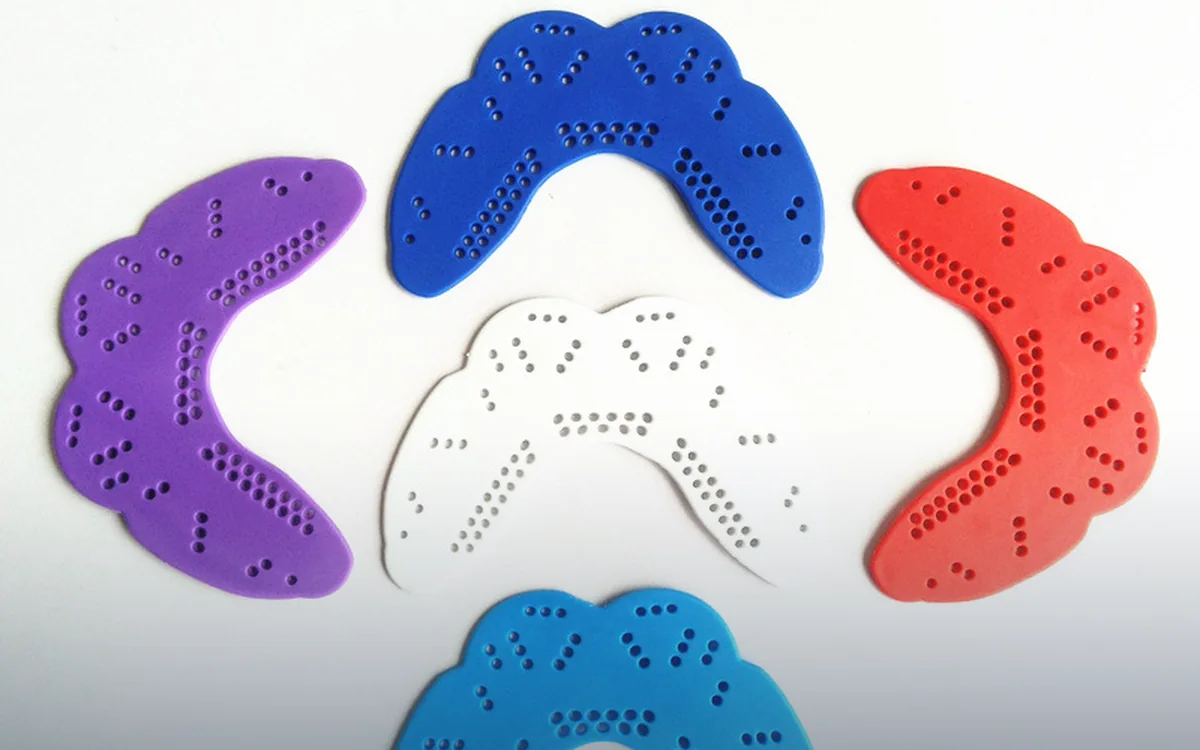
The minimum is 100 pcs per style, with a minimum of 50 pcs per colourway. That second number is the one that catches buyers. A single-style order in four team colours is not 100 pieces; it is 200 pieces, because each colourway needs its own run and its own setup.
This is not a sales rule, it is a machine rule. A colour change costs a purge, a setup and a first-off check, and 50 pieces is roughly the point where that work is paid for. Below 50 per colour, the setup dominates the piece and the factory either loses money or quietly substitutes a stock colour. If your launch needs six colourways, either accept 300 pieces or narrow the range to two colours and add the rest on the reorder.
Thickness is the material line
The working range is 3.0–5.5 mm, and thickness is the single most effective lever on material cost because it moves weight almost linearly. A guard at 3.0 mm runs around 30 g. At 500 pieces that is about 15 kg of guards; at 5,000 pieces it is about 150 kg. Push the wall to 5.5 mm and you are buying the better part of twice the material for the same piece count.
Thin is not automatically cheaper in the end. A 3.0 mm single-layer guard that tears at the molar edge in week three produces returns that cost more than the material saved. The usual compromise is 3.0 mm for a slim retail guard, 4.0 mm for club use, and 5.5 mm or a two-layer build for contact sports.
Decoration: the line that surprises buyers
Decoration has two costs and buyers usually price only one. The setup is per colour and per design: the plate, the registration and the first-off approval. The run cost is per piece and per colour. A one-colour moulded-in logo changes the tool once and then costs nothing per guard, which is why it is the cheapest option at high volume and the most expensive at low volume.
Printing is the opposite. There is no tool change, but every piece carries ink, every colour carries a setup, and registration on a curved shell is a tolerance you should agree in millimetres before the run. Ask for a printed sample on the actual shell, not on a flat card, because a logo that sits perfectly on paper can drift around the curve of a guard.
Case and packing: small parts, real money
The case is a moulded PP part at 82 × 72 × 32 mm with a living hinge tested to 5,000 open and close cycles. It is moulded in house, which matters at reorder: a bought-in case can change supplier and colour between batches without anyone telling you. Ask for the hinge cycle count in writing and test twenty cases from the first carton yourself.
Packing is 300 pcs per carton. That number sets your freight maths and your warehouse handling, and it is worth checking against the carton dimensions before you book anything. A 300-piece carton of 30 g guards is around 9 kg of product before packaging, which is light enough to hand-stack and heavy enough that a warehouse will not want to move 17 of them one at a time.
Worked example: 500 pieces against 5,000
Take one style, two colourways, 3.0 mm, one-colour moulded logo, PP case on every guard. Both order sizes meet the 100-piece MOQ per style and the 50-piece minimum per colourway, with room to spare.
At 500 pieces
Sampling takes 5–7 days, production takes 12–18 days after approval, and the material line is roughly 15 kg of guards. Freight is 2 cartons at 300 pcs per carton, so the order ships as a small consignment, which is where the fixed costs hurt. Tooling and setup are spread across 500 pieces rather than 5,000, so their share of the unit price is ten times higher. Inspection still runs at AQL 2.5, and the 30% deposit covers a smaller absolute amount but the same administrative work.
At 5,000 pieces
The same style, specification and two colourways at ten times the quantity. Material is now about 150 kg, packing is 17 cartons, and the fixed lines behave completely differently. Tooling and setup per piece fall to roughly one tenth of the 500-piece level, which is usually the largest single movement in the whole quotation. What does not fall as fast: the labour to trim and pack each guard, the inspection time, the decoration run cost, and the per-carton handling. That is why the per-piece curve flattens rather than falling in a straight line, and why a supplier who promises the 500-piece price at 5,000 has probably quoted the 500-piece specification.
| Line | 500 pcs | 5,000 pcs |
|---|---|---|
| Guard weight at 3.0 mm | 30 g per guard | 30 g per guard |
| Material volume | About 15 kg | About 150 kg |
| Cartons at 300 pcs | 2 cartons | 17 cartons |
| Tooling and setup per piece | Baseline | About one tenth of baseline |
| Decoration setup | Same per colour | Same per colour |
| Trim and pack labour per piece | Baseline | Close to baseline |
| Sampling | 5–7 days | 5–7 days |
| Production after approval | 12–18 days | 12–18 days |
| Inspection | AQL 2.5 | AQL 2.5 |
| Case | 82 × 72 × 32 mm, 5,000 hinge cycles | 82 × 72 × 32 mm, 5,000 hinge cycles |
Freight and terms change the landed number
The quoted price is the factory gate number, and what you actually pay depends on the term. Carton count is the number that decides your freight band, not piece count. An order of 5,000 guards is 17 cartons, which is small enough to consolidate and large enough that a forwarder will quote it as a minimum charge. Add a pallet allowance if your warehouse cannot take loose cartons, because that is a cost the factory will not include unless you ask.
| Term | What you are buying | Where the surprise usually sits |
|---|---|---|
| FOB Shenzhen or Yantian | Goods loaded on board, export cleared | Ocean freight booked late, or a rolled sailing |
| CIF | Freight and insurance to your destination port | Destination charges that sit outside the term |
| DDP | Delivered to your address with duty paid | Duty classification, and a freight line you cannot see |
| Payment | 30% deposit, 70% against pre-shipment inspection | Releasing the balance before the AQL 2.5 report arrives |
Where to push and where to leave it alone
The lines worth negotiating are the thickness, the decoration method and the number of colourways, because those change the actual work. The lines not worth negotiating are the case, the inspection level and the fitting temperature, because a concession there shows up as a return rather than a saving. A buyer who cuts the case to save a few percent usually spends the difference on replacement shipments and a listing that collects one-star reviews for a hinge that splits.
Send your target quantity, market and price point, and we will tell you which of those lines to move. Between 500 and 5,000 pieces, ask for both prices on the same specification and compare carton count as well as unit price.