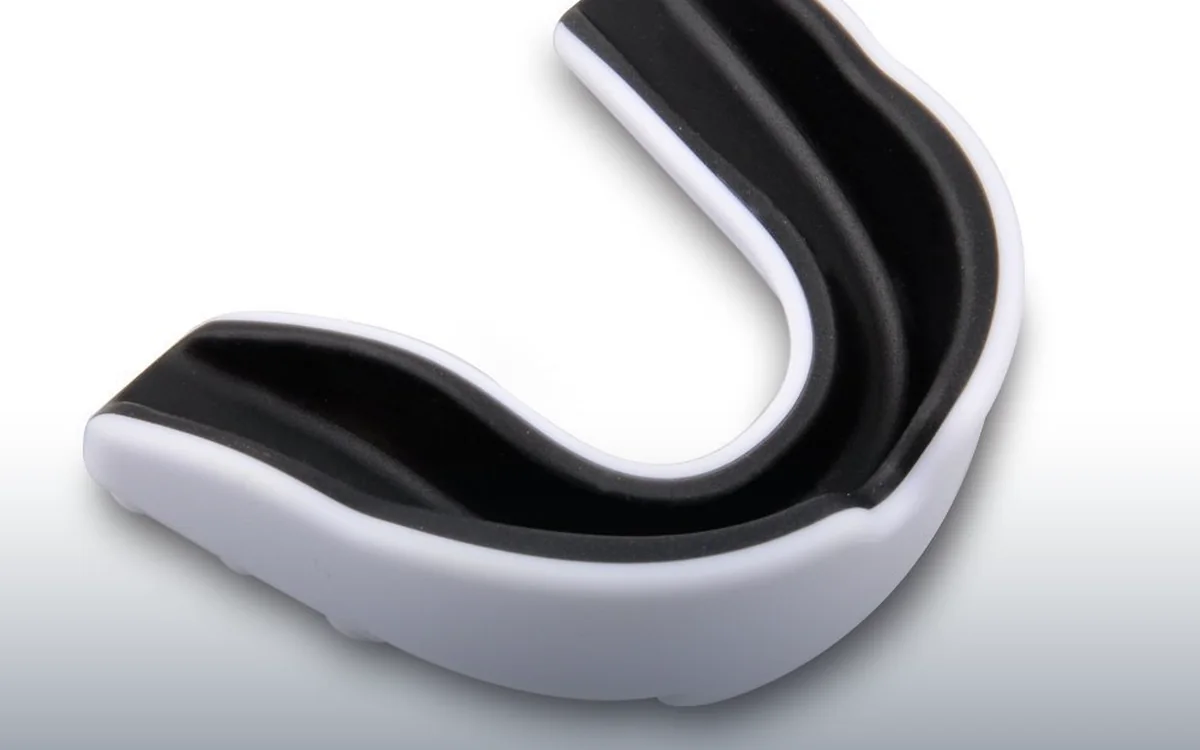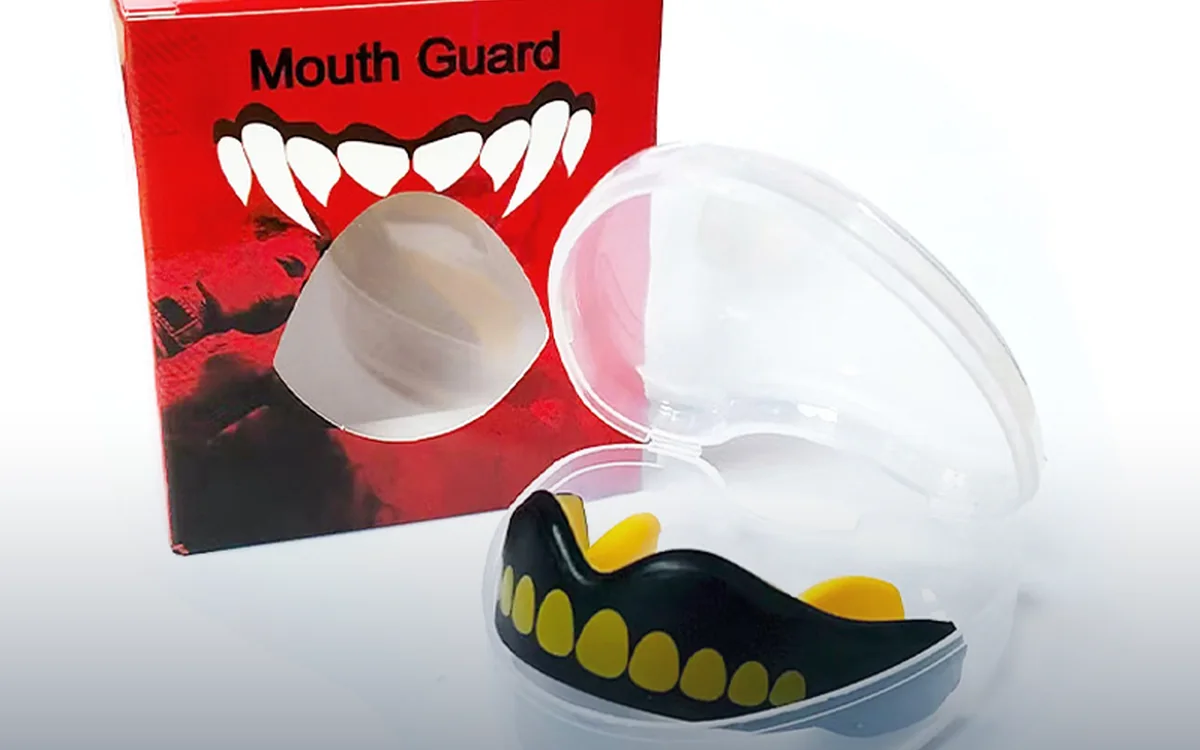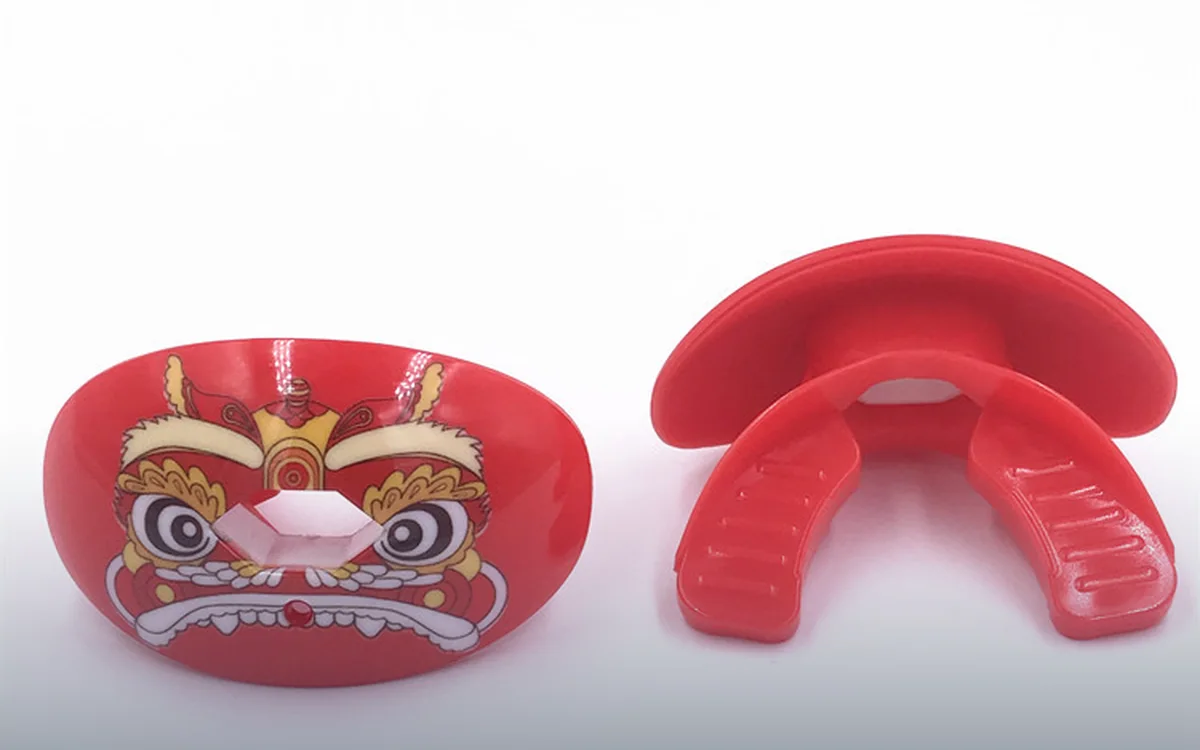
EVA, TPE and silicone are often treated as grades of the same product, and quotations encourage that reading because the unit prices sit close together. They fit at different temperatures and fail in different ways.
Three materials dominate the mouth guard shelf: EVA, TPE and silicone. Buyers often treat them as grades of the same thing, and a quotation encourages that reading because the unit prices sit close together. They are not the same product. Each one fits at a different temperature, trims to a different edge, holds colour differently and fails in a different way after a season in a kit bag. Here is where each material earns its place.
The three materials in plain terms
EVA is ethylene vinyl acetate, a closed-cell foam-like thermoplastic. It is the material behind most boil-and-bite guards sold at retail. It softens in hot water, takes an impression of the teeth, cools firm and stays slightly flexible. It is the cheapest of the three to mould and the easiest to colour, which is why it covers most team and school orders.
TPE is a thermoplastic elastomer. It behaves like rubber but processes like plastic, so it can be injection moulded to a tighter tolerance and a cleaner edge than EVA. A TPE guard fits at 70 °C rather than 75 °C, which shortens the instruction and reduces the chance of a customer overheating the part.
Silicone is a thermoset elastomer. It cannot be re-melted, so it is cured in a mould and trimmed by hand. It is soft, tolerant of repeated cleaning and stable at high temperature, which is why dental and clinical products use it. It is also the slowest of the three to produce and the hardest to decorate.
Fitting temperature decides the retail format
The numbers are close but the instructions are not. EVA softens at 75 °C; TPE at 70 °C. Both sit below boiling, so both can be sold as a boil-and-bite product, but the water handling differs enough to change your packaging. A TPE guard that a customer drops into water straight off the boil is being pushed past its working range, and the complaint that follows is a guard that never hardens properly.
Write the temperature on the instruction panel and the box panel, not only in the leaflet inside. Retail buyers check the panel because it is the part they photograph in a store. If your supplier cannot state it with a tolerance, the specification is unfinished.
Side-by-side comparison
The table below is the one to send with an enquiry. Fill in your own requirement in the right-hand column and the factory has a brief rather than a wish.
| Property | EVA | TPE | Silicone |
|---|---|---|---|
| Fitting temperature | 75 °C | 70 °C | Not heat-fitted |
| Working thickness | 3.0–5.5 mm | 3.0–5.5 mm | 3.0–5.5 mm |
| Guard weight at 3.0 mm | Around 30 g | Around 30 g | Around 30 g |
| Edge after trimming | Soft, slightly porous | Clean, sealed | Hand-trimmed, smooth |
| Clarity | Transparent EVA clears well | Translucent to clear | Clear or opaque |
| Colour matching | Easy, masterbatch | Easy, masterbatch | Harder, pigment cures in |
| Logo method | Moulded in or printed | Moulded in or printed | Embossed or printed |
| Re-fitting | Yes, repeated | Yes, fewer cycles | No, one shape |
| Cleaning tolerance | Mild soap, cool water | Mild soap, cool water | Hot water and steam tolerant |
| Tooling | Existing moulds common | Existing moulds common | New tool almost always |
| Sample round | 5–7 days | 5–7 days | Longer, cure and trim |
| Typical order | Team, school, retail | Club, private label | Dental, clinical |
Two rows decide most orders: fitting temperature, which sets your instruction panel, and trimming behaviour, which sets the edge.
Thickness, weight and protection
Material choice matters less than thickness for impact protection, and thickness is the number buyers negotiate hardest because it is the biggest material line. At 3.0 mm the guard is light, sits easily in the mouth and suits a slim retail product. At 5.5 mm it covers more of the occlusal surface and absorbs more, and it is noticeably bulkier to wear.
| Thickness | Guard weight, single layer | Where it fits | Risk if you go thinner |
|---|---|---|---|
| 3.0 mm | Around 30 g | Slim retail guard, boil-and-bite | Tears at the molar edge within a season |
| 3.5 mm | Around 35 g | School and club orders | Less material to trim, so edges vary |
| 4.0 mm | Around 40 g | Club and private label | Bulk that younger wearers notice |
| 4.5 mm | Around 45 g | Contact sports, dual layer base | Speech and breathing complaints |
| 5.5 mm | Around 55 g | Heavy contact, two-layer builds | Harder fit, higher material cost |
Weight follows thickness, and weight is what you pay for. A guard at 3.0 mm runs about 30 g, so 300 pcs per carton is roughly 9 kg of guards before packaging. Take a 5,000 piece order to 5.5 mm and the freight line moves before the material line does.
Where the cost per piece actually sits
Material price per kilogram is the number buyers ask about and the least useful one on its own. What moves the unit cost is the combination of part weight, scrap rate and cycle time. EVA and TPE scrap can usually be reground and reused within a controlled ratio. Silicone scrap cannot, so every rejected part is a full loss, and the trim step adds handling that thermoplastics do not need.
At 500 pcs the fixed costs dominate: tooling, sample rounds, colour matching and machine setup. At 5,000 pcs those costs spread over ten times the volume and the material line becomes visible for the first time. That is why a silicone quote at 500 pcs can look close to a TPE quote and pull away at 5,000.
Where silicone earns its price
Silicone is the right material when the product has to survive repeated hot-water cleaning, when the customer cannot boil a guard, or when the buyer needs a soft, non-thermoplastic feel for a clinical or dental-adjacent product. It is also the material for a gel liner that stays soft against the gum line in a hot car.
- Repeated cleaning: a silicone guard tolerates hot water and steam where EVA and TPE do not.
- No fitting step: the guard arrives in its final shape, which removes the instruction panel and the fitting complaint.
- Softness: a gel liner or a silicone base stays soft against the gum line under pressure.
- Thermal stability: a kit bag in a car boot does not change the shape of the part.
It is the wrong material when you need a printed logo at low volume, a colour match across six team colourways, or a 5–7 day sample round on a new shape. For those orders, EVA or TPE will do the job at a lower landed cost and with a much shorter path from drawing to carton.
Colour, clarity and decoration
Transparent EVA is the only material that reads genuinely clear on a shelf, and it is also the least forgiving: any discolouration in the lot shows immediately, and a clear guard that yellows after a month looks like a defect even when it is not. If you sell clear, lock the masterbatch code and ask for a retained sample from each lot.
Send a physical swatch per colourway and ask for a match under the same light. A moulded-in logo costs a tool change once and nothing per piece; a printed logo costs per piece and per colour, with a registration tolerance agreed before the run. Colour match the TPU tether to the shell, because a mismatched tether is the first thing a buyer notices on an unboxing photograph.
What to put on the purchase order
The material section of a purchase order should be specific enough that a new production planner could run the job without asking a question.
- Grade and supplier: the exact grade, plus a retained sample of the lot you approved.
- Fitting temperature: 75 °C for EVA, 70 °C for TPE, with a tolerance and the cooling time.
- Thickness: nominal and minimum at three measuring points inside the 3.0–5.5 mm range.
- Weight: 30 g per guard at 3.0 mm, with a tolerance that catches short shots.
- Layers: which material sits on the inside and which on the outside.
- Colour: masterbatch code and a physical swatch per colourway, at 50 pcs per colourway minimum.
- Packing: 300 pcs per carton, case at 82 × 72 × 32 mm, label and barcode position.
Get those lines into the order and the material conversation is finished. Send the swatch and the thickness, and we will tell you which of the 260+ moulds on file fits the shape.